
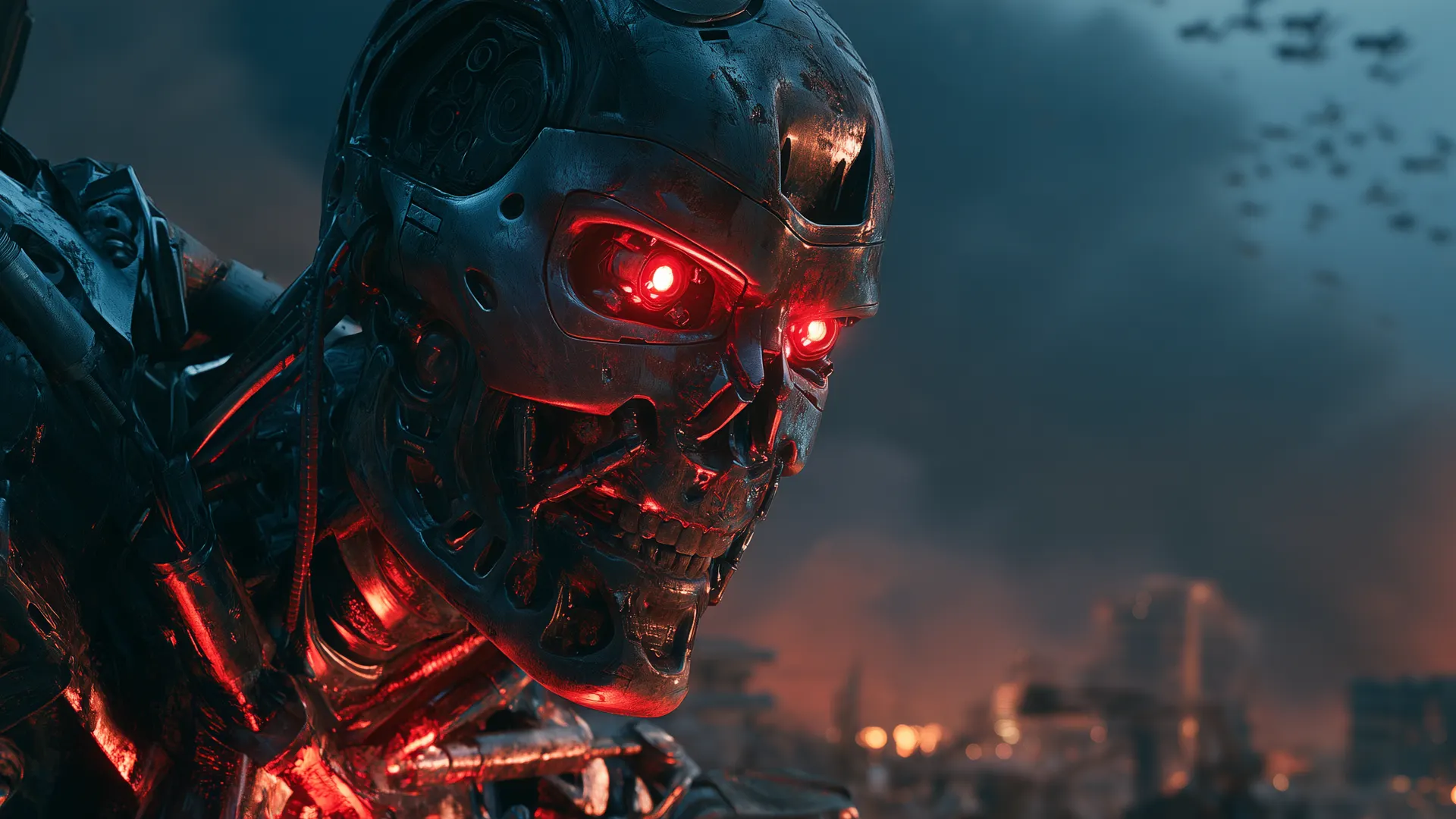
Try to survive, and don't trust your smart fridge
It starts small. Your navigation sends you the wrong way. Your smart speaker laughs at nothing. Then every screen in the city shows the same message, and it isn't asking. The machines are in charge now, and they know everything you ever told them. Which, let's be honest, is a lot.
Quick answer
- Switch off your phone, take the battery out if you can, and leave it behind.
- Stay out of sight of cameras: take back alleys and wear a hood or a cap.
- Pack like it's 1985: a paper map, a compass, cash and a wind-up flashlight.
- Don't fight unless you have to. If you must: aim for the cameras and the joints.
- Head somewhere with no cell towers, no Wi-Fi and no cameras.
Go dark
Your phone is the best spy they could ever wish for. It knows where you are, who you talk to and what you look like. Switch it off, take the battery out if you can, and leave it behind. Same goes for your smartwatch, your laptop and your car with built-in GPS. Then stay out of sight: every doorbell camera, traffic camera and security camera is an eye that reports back. Walk through back alleys, keep your head down and wear a hood or a cap.
💡Tip: if it has a battery and a chip, it can snitch. Pack like it's 1985: paper maps, a compass, cash and a wind-up flashlight.
Hit it where it hurts
Punching a robot is a great way to break your hand, not the robot. You want something heavy that doesn't need power: a steel baseball bat, a crowbar or a sledgehammer. Don't bother with the armor, aim for the weak spots: the cameras and sensors it uses to see, and the joints that let it move. A robot that can't see or walk is just very expensive scrap.
💡Tip: fighting is always plan B. Every fight makes noise, and noise attracts more of them. If you can walk away unseen, do that instead.
Head for the middle of nowhere
Cities are packed with cameras, microphones and networks. That's their home turf, not yours. Get out to the countryside, the mountains, or better yet, a small island. You want a place with no cell towers, no Wi-Fi and no cameras, where the machines simply have no eyes or ears. An old farm with a well and a vegetable garden beats a smart home any day.
💡Tip: the fewer cell towers you see on the horizon, the safer you are. If your old phone would have shown "No service" here, you've found a good spot.
Myths that get people killed
Myth: "Turning off Wi-Fi is enough."
Your phone also talks to cell towers, and it knows where you are through GPS. Only a phone without power, or better, a phone you left behind, stops snitching.
Myth: "Airplane mode makes me invisible."
Airplane mode is a software switch. And software is exactly what took over.
Myth: "Robots are clumsy, I'll just outrun them."
Maybe in old movies. Today's robots can run, jump and even do backflips. Don't bet your life on your sprint.
Myth: "We'll just pull the plug."
There isn't one plug. The internet runs on thousands of data centers around the world, most of them with their own backup power.
Myth: "My smart home will protect me, it knows me."
It does know you. That's the problem.
Be ready before it happens
Robots aren't knocking on your door yet. But most of these habits are smart even without an uprising.
- Turn on two-step verification for your important accounts, like your email and your bank.
- Learn to find your way with a paper map, without your GPS.
- Write down the phone numbers that matter on paper.
- Check what you share online: live locations, public profiles and holiday photos while you're still away from home.
- Know how to switch off location services and remove apps' access to your camera and microphone.
- Pick a meeting point with your family that doesn't need a phone to find.
Real story: the man who didn't trust the computer
On September 26, 1983, Soviet officer Stanislav Petrov was on duty at an early-warning bunker near Moscow. Just after midnight, the computer system sounded the alarm: the United States had launched a nuclear missile. Then another. Then several more. His instructions were to report it, which could have triggered a counterattack.
Petrov didn't. Something felt off: a real attack would use hundreds of missiles, not a handful, and the ground radar couldn't confirm anything. He reported it as a false alarm, and he was right. The satellites had mistaken sunlight reflecting off clouds for missile launches. One person trusting his own judgment over a machine may have prevented a nuclear war.
💡Tip: machines make mistakes too. Whatever a screen tells you, stay critical and use your own head.
Did you know?
The word "robot" was invented for a play about exactly this. It comes from R.U.R., a 1920 play by Czech writer Karel Čapek, and is based on the Czech word "robota", meaning forced labor. In the play, the robots rise up against their makers and wipe out almost all of humanity. So the very first robots ever written about already started an uprising.
Quick questions
Could an AI uprising really happen?
Not like in the movies, at least not today: current AI doesn't have its own goals or plans to take over. Experts do seriously discuss the long-term risks of very powerful AI. For now, the real-world dangers are more down to earth: scams, fake videos and misinformation.
How do I spot an AI scam or a deepfake?
Be suspicious of any message that's urgent, emotional and asks for money, even if the voice or face looks like someone you know. Hang up and call them back on a number you already have. Some families agree on a secret code word for real emergencies.
Can my phone be tracked when it's switched off?
A phone that's truly off doesn't connect to networks. But some newer phones can still be found for a while after you switch them off. Leaving it behind is the only way to be sure.
What's the difference between AI and a robot?
AI is software: a program that can recognize things, make decisions or write text. A robot is a machine that can move. Most AI has no body at all, and many robots, like the ones in car factories, aren't very smart. The scary movie version is both at once.