
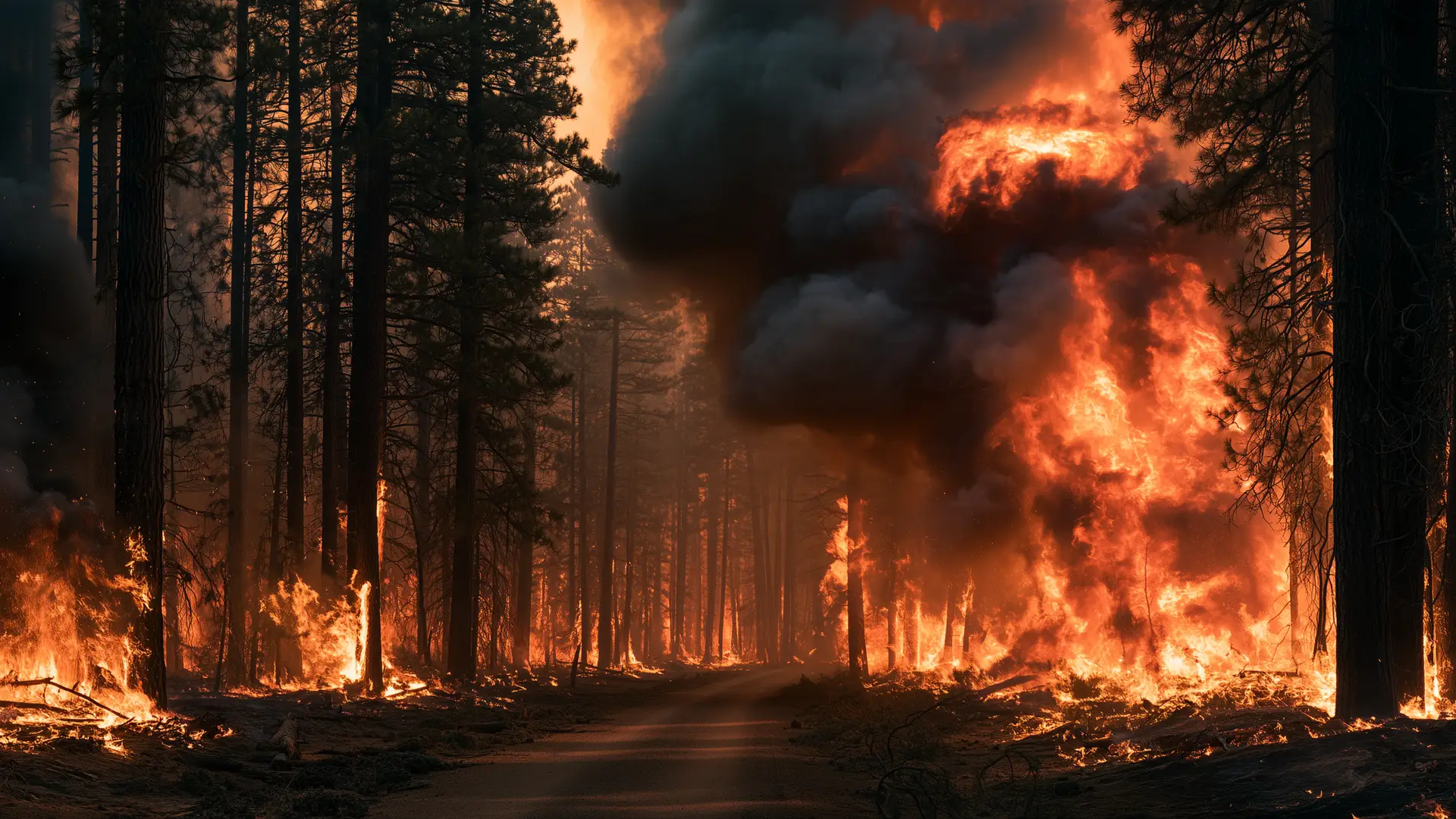
Try to survive, and don't play with fire
It starts with a smell. Smoke, somewhere far away. Then the sky turns orange and ash starts falling like snow. A wildfire can move faster than you can run, especially uphill, and it doesn't wait for you to finish packing. So remember one rule above all others: leave early.
Quick answer
- Leave early. When the authorities tell you to evacuate, go right away.
- Follow the official evacuation routes, and never drive towards the fire.
- Smoke: stay inside with the windows shut, or wear an FFP2 or N95 mask.
- Trapped? Stay in your car or house, or lie face down in a spot with nothing to burn. Never run uphill.
Leave early
If the authorities tell you to evacuate, go. Right away. Don't wait until you can see the flames: by then the roads can be full of smoke, traffic and fire. Many of the people who die in wildfires are caught while leaving too late. Grab your emergency bag, medicine, documents and a phone charger, and follow the evacuation routes the authorities give you.
💡Tip: during fire season, keep your car's tank at least half full and park it facing the road. When you have to go, every minute counts.
The smoke is dangerous too
You don't have to be near the flames to get hurt. Wildfire smoke can travel hundreds of kilometers and it's full of tiny particles that end up deep in your lungs. When the smoke reaches you, stay inside, close the windows and doors, and turn off anything that pulls in air from outside. Have to go out? A cloth or surgical mask won't stop those particles. A well-fitting FFP2 or N95 mask does a much better job.
💡Tip: children, older people and anyone with asthma or heart problems suffer the most from smoke. Keep an extra eye on them.
If you're trapped
Sometimes you just can't get out in time. Call the emergency number first, then:
In your car: park away from trees and bushes, close the windows and air vents, lie down on the floor
and cover yourself with a wool blanket or jacket.
At home: stay inside, close the windows and doors but don't lock them (so firefighters can get in),
fill sinks and bathtubs with cold water and stay away from outside walls and windows.
On foot: get to a spot with as little vegetation as possible, like a road, a rocky area,
or a ditch or dip in flat ground, lie face down and cover yourself up. Never try to outrun a fire uphill: fire climbs faster than you do.
Want the official version? The US government's Ready.gov wildfire guide explains what to do before, during and after a wildfire.
💡Tip: never drive towards a fire to "take a look". Sightseers block the roads for fire trucks and for people who are trying to get out.
Don't be the spark
Most wildfires don't start with lightning, they start with people: in the United States, the National Park Service says nearly 85% of wildland fires are caused by humans. A campfire that wasn't put out properly, a cigarette thrown out of a car window, a barbecue on a dry and windy day. Respect fire bans, and always put a campfire out completely: drown it with water, stir it, and drown it again.
Myths that get people killed
Myth: "I'll stay and save my house with the garden hose."
Water pressure drops, the power goes out and the heat is unbearable. Late decisions, like staying to defend and then trying to flee at the last minute, are one of the most common ways people die in wildfires.
Myth: "The fire is kilometers away, I'm safe for now."
Wind can carry burning embers far ahead of the fire and start new fires where nobody expects them. Distance buys you time, not safety.
Myth: "Green trees don't burn."
In a hot, dry wind, living trees burn too, and trees full of oil or resin, like pines and eucalyptus, can go up like torches. Green doesn't mean safe.
Myth: "It's a small fire, the firefighters have it under control."
In strong wind, a small fire can grow into a huge one within hours. Keep an eye on the alerts, even if it looks like nothing yet.
Be ready before fire season
A wildfire gives you minutes, not hours. Everything you can do in advance is time you don't have to find later.
- Clear dry leaves, branches and dead plants from around your house and out of your gutters.
- Move firewood, gas bottles and anything else that burns easily away from your walls.
- Know at least two ways out of your neighbourhood.
- Sign up for local emergency alerts.
- Keep your important documents together in one folder, or save digital copies, so you can grab them in seconds.
- Pick one room you can close off against smoke, and if you have an air purifier, put it there.
- Have a plan for your pets, and keep their carriers somewhere easy to grab.
Real story: the town that ran out of road
On the morning of November 8, 2018, the Camp Fire started in the hills of Northern California. Pushed by strong winds, it reached the town of Paradise within hours. Thousands of people tried to leave at the same time, on just a few roads.
The roads jammed, cars caught fire, and people abandoned them and ran. Firefighters had to use bulldozers to push burned-out cars off the road. 85 people died, and almost the entire town burned down, making it the deadliest wildfire in California's history. The people who made it out safely were often the ones who left first.
💡Tip: stuck in slow traffic in the smoke? Close your windows and vents, set the air to recirculate, and keep your headlights on so other drivers can see you.
Did you know?
During Australia's "Black Summer" of 2019–2020, bushfires raged for months across the country. According to a study commissioned by WWF, nearly 3 billion animals were killed or lost their homes: koalas, kangaroos, birds, reptiles and frogs.
Quick questions
How fast can a wildfire move?
In strong wind, a grass fire can move faster than 20 km/h, faster than you can run. Forest fires usually spread more slowly, but burning embers can jump far ahead. And uphill, any fire speeds up.
Do I have to wait for an official evacuation order?
No. If you feel unsafe, leave. That goes double if you have small children, older family members, pets or horses: they need extra time to get out.
What if my clothes catch fire?
Stop, drop and roll. Don't run, because running feeds the flames with air. Drop to the ground, cover your face with your hands and roll back and forth until the fire is out.
When can I go back home?
Only when the authorities say it's safe. Even after the flames are gone, there can be hidden hot spots, falling trees, broken power lines and toxic ash. Wear a mask and gloves when you start cleaning up.